

Paul
Gallery Support
I started at the Lowry on the 2nd of October, 2000. I’ve seen a lot of changes since then. When it opened, we had an exhibition space upstairs. That’s offices now. At the opening we had an
exhibition of Shirley Baker photography, all about Salford, the streets and children playing. That was along the Promenade gallery. The Lowry was designed by Michael Wilford, who was the head architect. It was begun in 1997 and then by 2000 it was fully built. It was opened on the 28th of April 2000.
Then there was 20-minute film in the Lookout about Lowry’s life you could watch, and we had the Lowry’s at the back and the special exhibitions at the front, and then that swapped round. Now we have Lowry 360 immersive in Gallery A as well.
Before coming to the Lowry, I worked at Princes Park Garden Centre in Irlam. I used to work as a landscape gardener, potting plants up, pricking them out. Sometimes I worked at the shop, selling plants, and some of the plant foods, lots of fertilisers, helping plants to grow better. Then I worked at the Salford Museum and Art Gallery on the Crescent, where the Lowry Collection was before. The Collection moved over to Lowry and then I left Princes Park in September, 2000 and then in October, I got the job here.
My job is Gallery Support, I work Tuesday ‘til Friday. I start work at about half twelve until five pm. I talk to visitors about the exhibitions. Sometimes I do the Lowry 360. I use the iPad to operate the immersive videos. First I ask visitors to take precautions - not to eat your food and drink and not to take photographs or video, please be aware there's strobe lighting, fast movements, a loud voice over with music. Then it starts and I’m there to help. I really enjoy my work. One of my favourite things recently was the Quentin Blake exhibition because children really like it. I like it. Adults like it. They’ve got a boat in the middle of the gallery that everyone likes.
One of my favourite paintings in the collection is Man Lying on a Wall, painted in 1957. Lowry
worked at a property company in Manchester as a rent collector, but by the time he painted this he was retired. I picked it because it kind of looks like Lowry. He actually saw this scene, the man on the wall and the church, and the umbrella, when he was on the bus going to Blackburn and I like to think he said, oh, that's me when I retired.
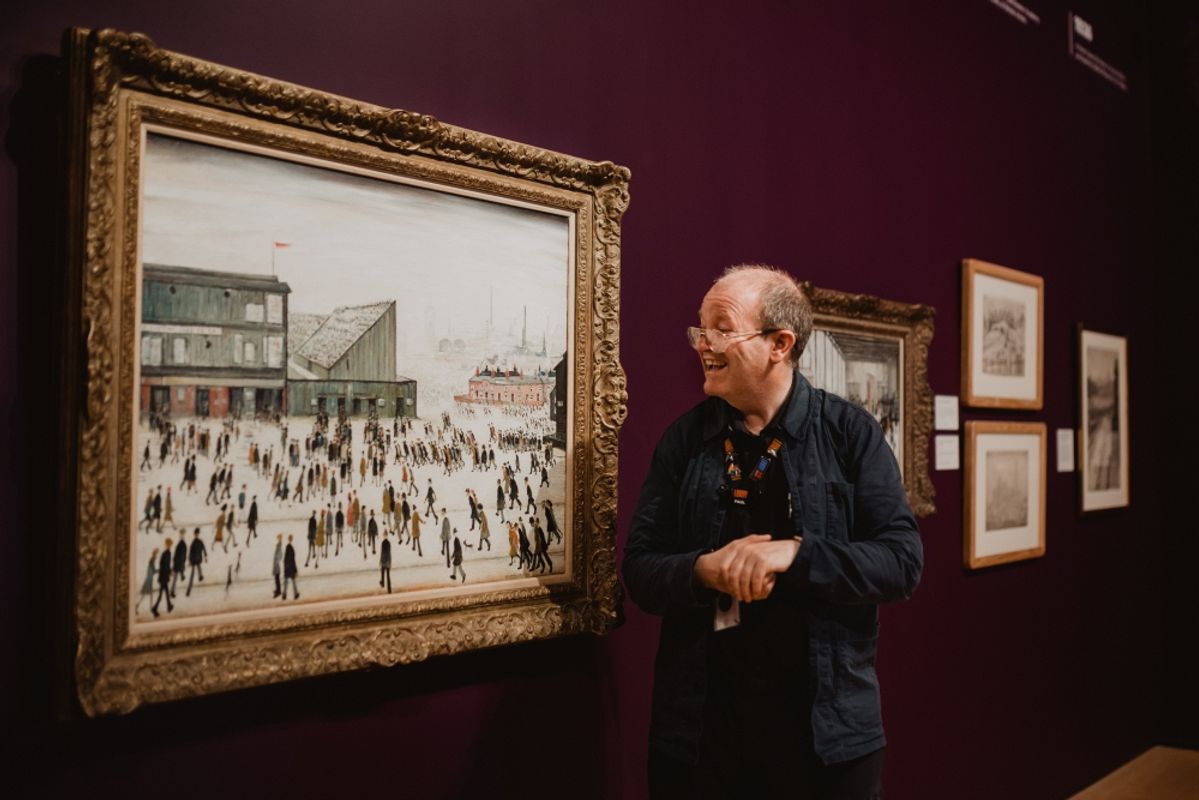
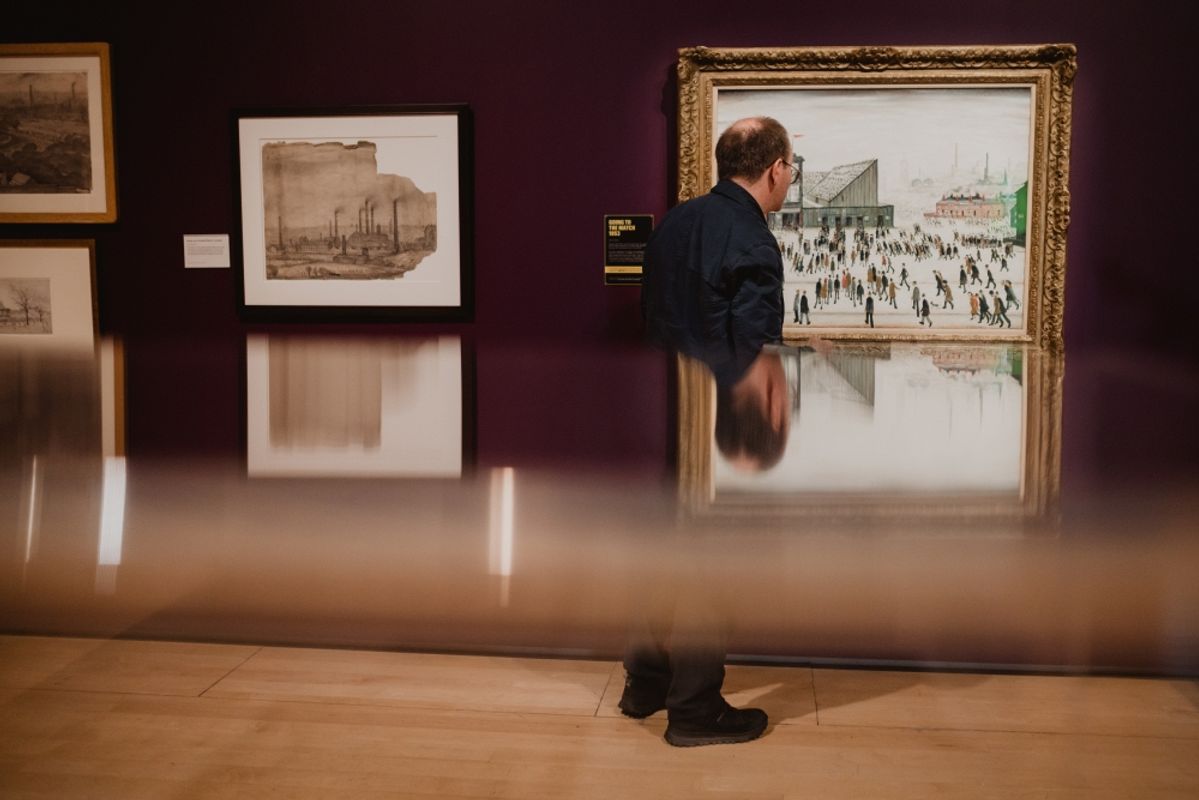
My favourite painting to talk to visitors about is Going to the Match, because that's very intelligent. He had five colours, no more. He used vermillion red, yellow ochre, Prussian blue, black and white, no medium. So he used a white lead paint all over the canvas, and it’s a very strong stuff, it’s not allowed to be sold in the shops because it’s poisonous. Then over the years, it turns creamy white. He mixed the colours to make green, brown, grey for the clouds, but he didn't paint the sun. Going to the Match was painted in 1953, the year when Bolton was playing Blackpool in the cup finals. You can see the factories and the terraced houses in the background, the industrial landscape that he is famous for. The stadium is getting a bit old, they pulled it down. You can see the different ticket prices, the more expensive one is 3/6. The cheaper one had no seats, so you have to stand without getting crushed. And in the foreground is all the people and even dogs.
I like to talk about the seascapes, which Lowry did when he went to Blackpool, Sunderland,
Berwick-upon-Tweed and Rhyl in North Wales. A dealer saw Seascape, and said hang on, there's nothing there, no chimneys, that's a waste of time. No actual buildings, nothing, just the sea. Nothing but the sea. Lowry painted the seascapes after the death of his mother, and it’s an expression of loneliness and sadness. After that he spent many holidays in Sunderland, at the Seaburn Hotel. He would sketch the characters he saw. Lowry didn't have a sketchbook so he’d use a receipt, or sometimes the back of cloak room tickets, doodling characters. Sometimes he fumbled in his pocket to pull out an envelope or bank statement, sometimes letters to Lowry, and on the back he did drawings of people, their different expressions, sketching people around Manchester, sitting on a park bench copying people.
We also have a drawing by Adolphe Valette, who was Lowry’s teacher. He was a French Impressionist. He was born in Saint-Etienne in France, then he moved from France to London to study at Birkbeck College. And then after that, he moved north to design artwork for a printing company. He also started at evening classes in Manchester, on Oxford Road, then after a while he wanted to join as a dedicated teacher, and he taught Lowry.
In the gallery is a charcoal. It’s of a statue of the Roman general Germanicus holding a cloak. Next to it is Lowry’s own version which is in pencil. Valette liked the dark colours in Manchester. He did a picture of the Refuge building that was in Manchester, and then he did the Hansom cabs, and he did the All Saints Church that was on Oxford Road. He did everything and he showed Lowry how interesting it was to look at the city.
Really, Lowry was a working-class hero. He was a rent collector, working for the Pall Mall property company in Broad Street in Manchester, which is not far from Sam’s Chop House. I show the visitors that there’s still a life-sized statue of him sitting at that bar with his sketchbook and pen. There’s a very sad loneliness to some pictures. Lowry looked after his ailing mother after his dad died in 1932. She took to her bed for about for seven years until her death in October 1939. So they did an x-ray of Head of a Man, behind it was a portrait of a woman, Lowry had painted over it. He woke up one morning on the way to work, looked at his bathroom mirror and that's what he saw. He’d been crying.
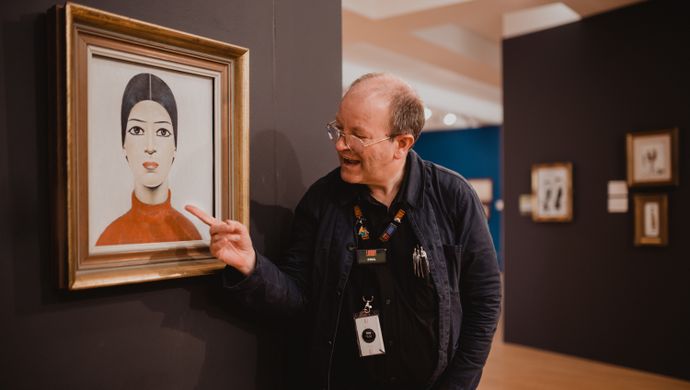
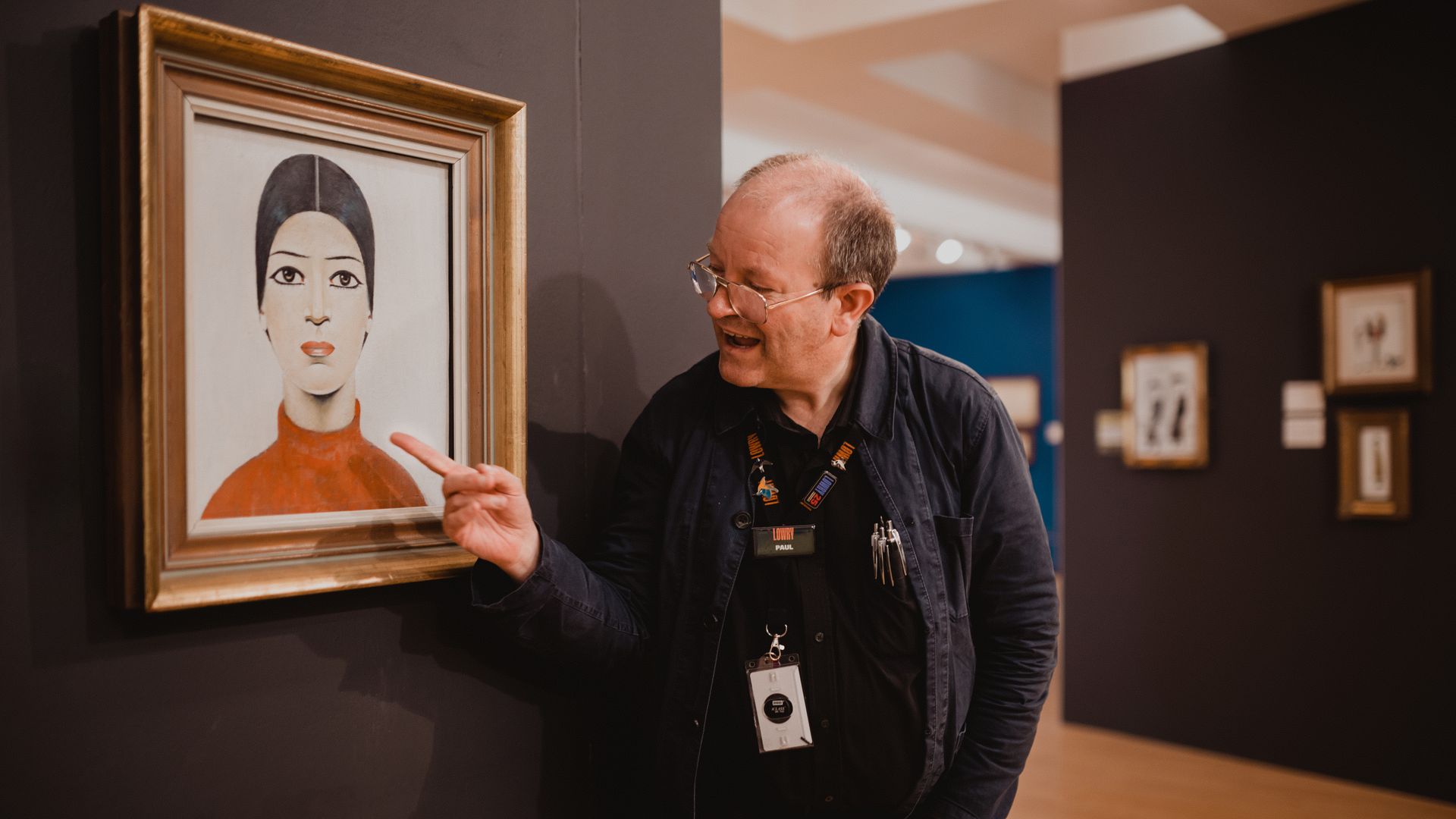
Portrait of Ann was painted in 1957. When it was put forward for an exhibition, they thought they would be getting something to do with an industrial landscape, like factories or mills. And they got this painting of a young woman. I can imagine them saying, ‘Hang on, who's that?’
Well, a journalist tried to track Ann down. They thought it might be Ann Helder, who Lowry said was his god child.
Or it might have been someone from Leeds or Lytham St Anne’s. Or maybe a tennis player? It
might have been someone he imagined. They never figured out who it was. It's a mystery today.