

Alice
Theatre Maker
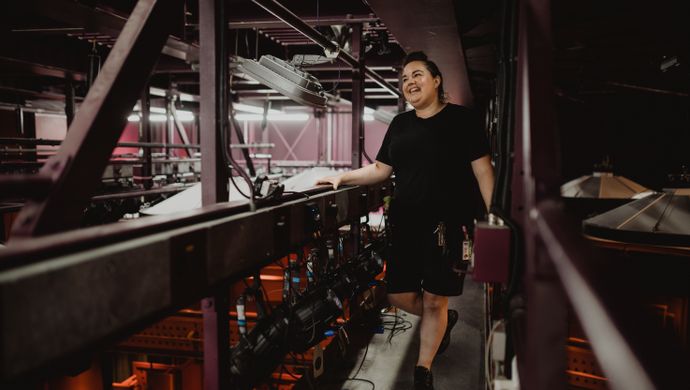
I was the shyest kid ever. Then I got a part in the school play when I was about nine. It was a World War Two variety show and I had so much fun. I just loved it. From there I just knew I wanted to do something in the arts. At first, I talked myself out of acting, because I really didn't think it was viable for someone visually impaired, which is ridiculous, but that was the brunt of it. I’d just have been happy to just to work in the arts.
Art is around us all the time. You can find it everywhere. It's a chance to escape from your mind, or relax, or see a story that resonates with you, that makes you not feel alone. I think there's a power in that. Growing up, it was that escape. I wasn't a big theatre kid, we didn't have the money. I wasn't in an art world. My family aren't. But art was that place to escape and feel things. I think it’s play, isn't it? You find your identity through expression.
So I knew from quite early that it was going to be the career that I wanted in whatever realm it could be. It's the creation, it's the joy. It's devising, it's creating work, I just knew I needed to be in a space like that.
I did my undergrad at Liverpool John Moores after which I saved up and did my masters at ALRA North, which was great. Then, moved to Manchester. Adopted northerner!
When I graduated from ALRA, I was really fortunate with the opportunities I got. I was applying for everything and that’s when I saw Lowry’s Developed With programme and I thought, I'm going to give it a go. I got really nervous, because I realised how good an opportunity it would be, that it had the ability to really change my career. I sent in the quickest application and tried not think about it too much. So it all came about because I just applied on a whim and thought, I'll never get this. And I got it!
My initial pitch was about how creative access in theatre, and disabled people working in theatre, is often categorised as a sort of sub-genre. After my first play, Past Life, I had noticed the difference in the climate around those sort of things. I was on the Royal Court writers’ programme and had written my second play, FADE, so I used that to pitch.
I wanted to explore how I could create a mainstream production that is creatively accessible and really steer forward a new way of thinking about how we can advance the technological aspects of creative access and theatre, and doing that with disabled people, rather than for them.
So I looked at how I can train up people, how I can employ a 95% disabled-led team, and then put on the production in the Studio. We did a creative access insight day through it as well, and you could see how it had transformed from that initial pitch.
It's important for me to understand how to create these spaces that are accessible. I formed a company, LALA Arts, which is about trying to take it from the individual and make it a movement of people. At the end of the day everyone just wants to make art and have a good time and tell stories. That's all it is. The world is on fire, and the disabled world is on fire, like everything else. But, instead of getting overwhelmed by the negativity, how can I positively be proactive in trying to make changes, even if it's tiny?
FADE was a whirlwind. It was a crazy experience. We had a team of 25, 95% of that was disabled people, a cast of four. It was so different, but it was really interesting to see what a team looks like when you've got everyone that you need in it. I discovered so much about how that creative access director relationship works.
It was nice as the lead artist to reflect on how we can communicate access needs and how we can communicate back to the director, creative notes from our access team. So we have our audio description consultant, creative captioner, and then me leading those conversations.
We sold out two nights at Lowry. I was so happy and the feedback was really beautiful. It was the first version of FADE, and I feel like there'll be a future one of it as well. It was really nice as the writer to see the bits that meant something to me, mean something to the audience. I think those discoveries are really, really beautiful.
It was massive, and it was such a big step-up in just the sheer size of that project. But everyone touched upon how their access needs felt met, and that they were able to have that voice and be able to work towards it in a safe environment. We had wellbeing sessions put in because the play is quite heavy covering quite big topics. So it was really lovely to be the person who'd orchestrated a production that had the tools put in place to safeguard everyone on it.
I think, to me, it just proved, if I can do it, then bigger companies can and should be doing it too. That's where La La Arts came in. We did a whole day for artists and organisations to come and look at how we approached lighting and captions, and what that does for the story, audio description, movement and sound, how they all work together.
We brought in the team to give people free tips and advice on how to do it cheaply. And then we had a big Q&A session. Manchester Sight Loss Council came in to give feedback. So it's about getting the community's voices in, asking how can we provide opportunities for people to step into the process, feedback, come to free events, so then hopefully come to the show and give discount on tickets and things, because accessible theatre starts with access to theatre.
It got to a point during development, where, luckily, I was getting a lot of opportunities coming to me, but I thought, I'm only one person. I'm really burning out. How can I create an environment, create a company where these opportunities can come but there's a team of people that I've trained up.
I’ve been doing a TV show in Canada the last couple of years, which was great and such a whirlwind opportunity, but it gave me a chance to really test that.
I got my ADHD diagnosis a few years ago, and my neurodivergent work really comes down to the way in which I run rooms and facilitate those spaces. I've been told that the rooms that I've created are some of the most accessible people have ever been in. I think it's communication. It's making a space, structural improvisation, going with what the vibe in the room is rather than this regimented idea that rehearsals have to be 9am till 6pm. Someone just made that up years ago, and that's the only way it's ever been done ever since.
I think that the way in which I orchestrate rooms, the people that I bring together, has really helped people who are neurodivergent be able to be their best selves, because it's unapologetic. But then it's difficult, because you can't be accessible for everyone. For some neurodiverse people who really appreciated the sounds and the vibrations and the colour, others were like, this is too much, but you have to own that.
That's the difficult thing about the work that I do, is you put yourself in a really vulnerable position. That’s the advice I give to people when I'm consulting on their projects, because it can be a really vulnerable position when things don't go right.
I'm in a phase of career that's a lot of governance and business and finance. As my career starts to grow, that's where I've now met the most access barriers. I think that's because we don't see these people in these positions of power, we don't get told about it. We don't have the money to fall back on if something goes wrong, and take the risk of making a company.
I do a lot of work helping people get their funding. I feel like there's so many routes my career could go down. But there's a beauty in saying no. It can be so difficult, but I find it quite empowering. You don't want to take that risk, but you have to sit in uncomfortable bits.
Community is often forgotten, especially in a post-lockdown world. A lot of our work is individual, and I don't think any of us went into this career to be sitting at a screen all day, sending emails on our own. So it's building up that community through a project.
My next play 90 + 5 is about the omnipresence of football in our lives. It’s a mad play delving into football history, burn out, the state of the world and our female identify but at its core, it’s a celebration of friendship and finding hope. We’ve been doing workshops with people at United Foundation, Liverpool Foundation, Burnley Youth Theatre, Derby County Community Trust and National Football Museum.
We made an exhibition of all of the work that we created through these workshops about what football means to us. So that exhibition is going to Local Exchange festival in Leigh with the Royal Exchange in August, then we're continuing those workshops on with the community groups, and expanding it a bit further.
Working in the disability world can burn you out really quick. It can take its toll. At times you're like, why am I doing this? If they're going to cut Access to Work, and funding is hard to find, it can just be a lot. But then I try and take that and turn it into something useful, because otherwise it's too much, isn't it?