


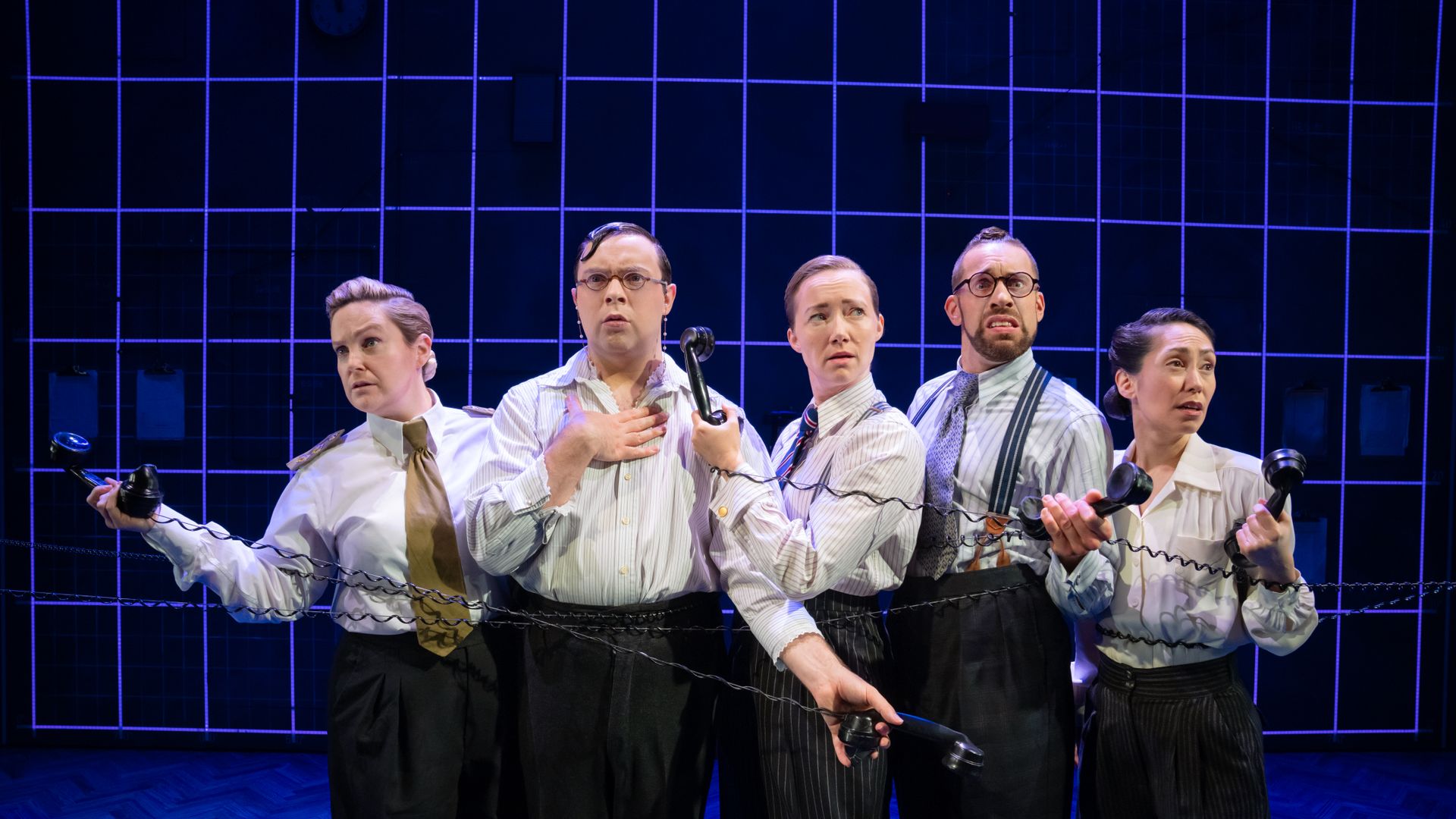
Ahead of the launch of the World Tour at the Lowry, read how SpitLip, the team behind Operation Mincemeat, created the award-winning show that's conquered the West End & Broadway
By Peter Marks, The Washington Post's former chief theatre critic
Who could have imagined that the most uproarious musical in years would find its zany inspiration from … James Bond?
“We just had been devouring every kind of source we could for telling the story of ‘Operation Mincemeat,’” Felix Hagan recalled, and we'd come to this realisation that it chimed every macabre, sick, twisted bell in all our horrible heads.”
Hagan is one of the members of SplitLip, the madcap comedy collective that in 2017 came up with a wild premise: turning the tale of an improbably brash British wartime escapade, into an improbably brash British musical. And that what would seal the deal early on was that one of the real-life characters in the tale of this mind-boggling gambit — a major World War II turning point for the Allies — was none other than the author-creator of Agent 007.
“By miles, the funniest thing that we could think of at the start was that Ian Fleming was involved,” Hagan noted.
And off Hagan went with the other SplitLip members — Natasha Hodgson, Zoë Roberts and David Cumming on a creative binge that would eventually lead to London’s West End, and then to Broadway.
Now, having earned critics’ raves (87 five-star reviews and counting) and Olivier awards along the way, Operation Mincemeat, directed by Robert Hastie, heads out on its first U.K. tour. It begins, aptly enough, on Feb. 16 at Lowry in Salford — the theatre that hosted its very first scratch performance.
To Roberts, who along with her SplitLip partners collaborated on the show’s book and score, the surprise and pleasure of the project has been its multi-generational appeal. “There’s something really joyful in the success of ‘Mincemeat,’” she observed, in a joint interview with her fellow SplitLip-sters, “and that has been the breadth of the age ranges, the backgrounds, the genders who enjoy it, and that, you know, that's great.”
For those who have yet to sample “Mincemeat,” a brief tutorial: Five actors play more than 80 roles in the musical, about an MI5 plan to fool the Nazis about where an Allied invasion of Italy was to occur. The story, in fact, has all the earmarks of a plot hatched by Fleming himself, who was an MI5 operative at the time.
That plot involves planting misleading invasion plans on the body of an Allied pilot who supposedly has crashed into the sea off the coast of Nazi-infested Spain. Which means the MI5 spymasters must procure a body, find a way to plop it in Spanish waters with the fake plans, wait for the Nazis to discover the body — and hope they fall for the ruse.
Still with me? The story is demonstrably true, down to the fact that the Germans were completely duped, leading them to move their forces to the wrong site of the supposed invasion. This paved the way for the Allies to launch, virtually unimpeded, a campaign to recapture Italy.
Of course, the musical is a witty riff on this beguilingly clever bit of spycraft. But the emotions it rouses, undergirding the ordeal of World War II, go deeper for British audiences. “For everyone that went to school here, that's something that they would have covered,” said Christian Andrews, who plays the prim, kindly secretary Hester (and other characters) in the U.K. tour. “My great auntie loved telling us about the war — I think she must have been like 16 or something when World War Two started. And yeah, I adored sitting down and listening to her.”
It is the essence of that idea, of gathering round to be regaled by a mesmerising bit of history, that “Operation Mincemeat” bottles so well. And all the more astonishing, because the SplitLip posse had never written a musical before.
“A few weeks ago, one of the wardrobe assistants, Billy, said to me, ‘Did you know that “Sail on, Boys” is a ‘charm song’?” said Hodgson, who plays Ewen Montague, the devilishly devious head of the MI5 team. And I was like, ‘What's a charm song’? He's like, ‘What do you mean? It's a type of song in musical theatre.’ I was like, ‘Oh my God, I'm being taught musical theatre in my own Broadway show by one of the wardrobe assistants!’
As Roberts noted, the group chose this narratively-rich source material “because we wanted to do something with a bit more commercial appeal” than some of the weirder, cabaret-style work through which SplitLip had gained a cult following. But when it came to writing the score, the focus became on mining various musical genres, from period ballads to contemporary hip-hop, for the humour or pathos the scene required.
“We approached every number completely with a clean slate as to what is the correct musical palette for this one song,” said Cumming, who originated the role of Charles Cholmondeley, the nerdy MI5 conceiver of the subterfuge. “And so we were less thinking about who's going to be watching it; we were like, what does the story require in this moment, for this moment to be the best it possibly can be?”
This was certainly true for what has become an emotional high point of the production, when Hester, played to Tony and Olivier-winning acclaim by Jak Malone, strums the audience’s heartstrings in the plaintive memory song, “Dear Bill.” The number is an instant theatre classic, revealing the story of Hester’s love for — well, why spoil the three-hanky moment?
“I had the privilege of seeing Jak do it before I touched the material,” recalled Andrews, who understudied before taking over the role in the production still running in the West End’s Fortune Theatre. “So the sense of who this version of the woman is was quite clear to me as a blueprint from Jak. And I think I was actually a bit naive as to how hard it is because of how brilliantly Jak did it.”
Alongside Andrews, Holly Sumpton, Seán Carey, and Charlotte Hanna-Williams return from the West End production to reprise their roles in the touring cast, joined by new recruit Jamie-Rose Monk. Audiences across the country will now be able to savour the SplitLip treatment of a singular slice of British history. Come to think of it, by means of virtuosic farce and an uncanny mastery of both gender-switching role-playing and the art of the quick-change, SplitLip seems to have been singularly destined for this assignment.
“We love this story,” Hodgson said. “What felt funny about it, and what felt true about it, and what felt difficult and naughty.” The musical indeed ricochets from one emotional tone to another, from moments detailing little human absurdities during wartime, to evocations of the monumental human toll.
Or as Hodgson put it, speaking as much about life as about “Operation Mincemeat”: “Things can go from being funny to tragic in a room, every day of your life.”