


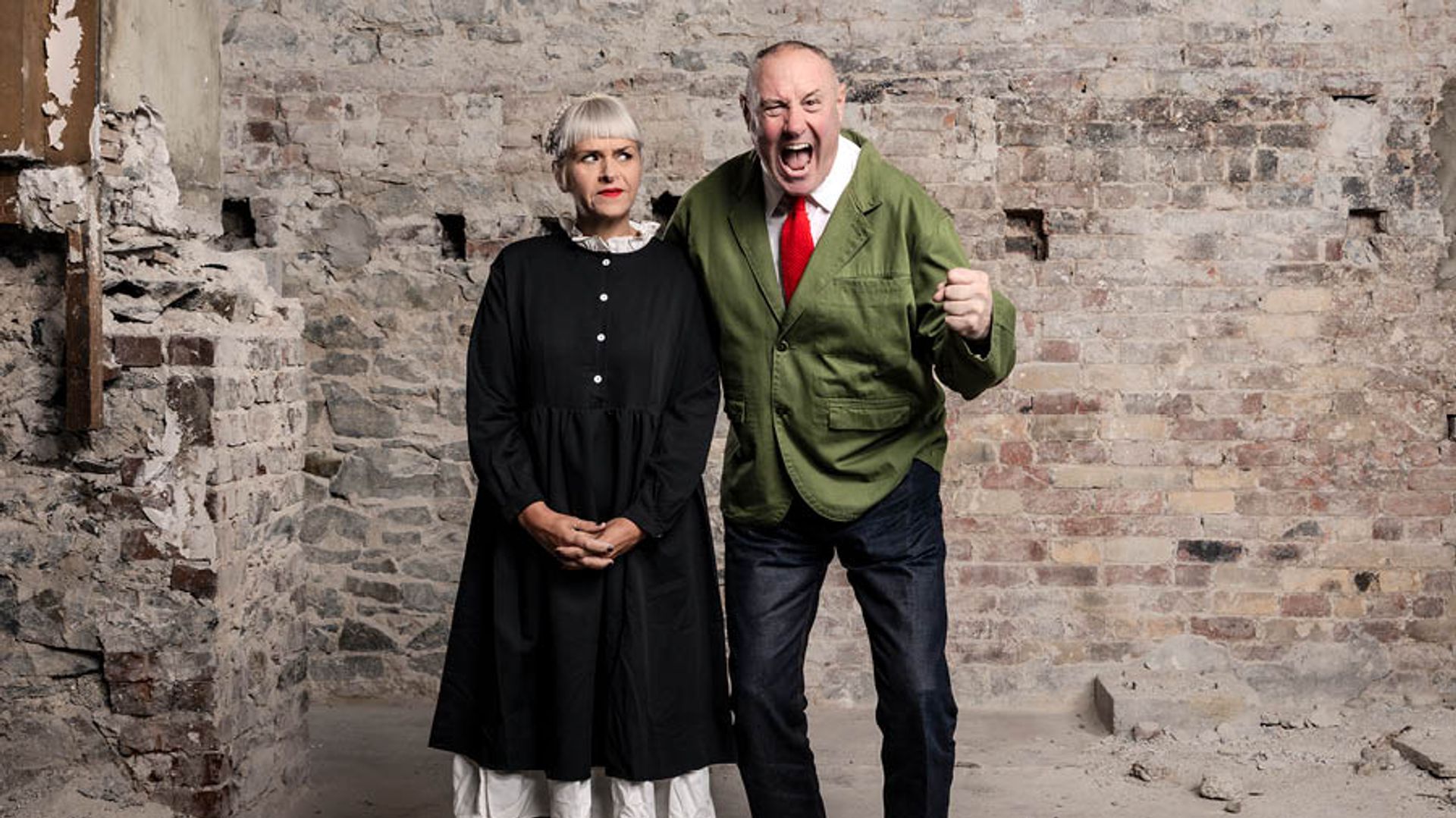
Interview with Keith and Marj
Interviewer: The title of the show is Us, Pots and a Welsh Chapel, could you elaborate on what each of those three elements represents and how they weave together to tell your story in this new live format?
Keith: Well, basically "Us" is us. The algorithm of how we got together, which is quite interesting. And then obviously a bit more of a background, not so much me but about Marj really because it's apparently it's not all about me.
Marj: I know. It's a shock.
Keith: I didn't realize that. I'm actually a bit annoyed about that.
Marj: Well, you're going to have to get used to it.
Keith: Hopefully we can connect with the audience about how people meet. And it's quite weird how we all have this sort of path that leads us to the right person really. So that's what the "Us" is about. There'll be a lot of self-deprecation. No doubt Marj will take the mick out of me quite a bit and I'll probably take the mick out of Marj.
Marj: Oh, no.
Keith: So it's quite light-hearted banter. And then the "Pots" really is about, as it says on the tin, pots, but also about the studio and what our goals are for the studio and what we can do within that. And the ‘Pots’ bit is also about Marj making other things.
Marj: And how we've both at times had to sort of make do and mend. You know, in certain periods of your life, you can't afford the things that you want, so you make them.
Keith: Absolutely. And that's what we'll be talking about.
Marj: And the ‘Chapel’ really is the umbrella that we both sit under, quite literally. The Chapel is at the heart of everything. I don't have children, but sometimes when people have children, all they can think about and talk about is children—and we're a bit like that with the Chapel. It's fundamental to everything we do.
Keith: Yeah. It is. We’re very much focused on it and some of the mad stories that have happened while we’ve been reinventing the chapel, but also restoring it; the people that we've met and the people that we are there.
Interviewer: You describe your relationship as a creative partnership and yourselves as partners in life and crime. How has working together on a project as ambitious as Capel Salem deepened your creative collaboration?
Marj: I know for me the project made me more confident as an individual. My voice in the creative decisions that we've made has gotten louder, I think.
Keith: Yeah. And rightly so. We're both people that know what we like and like what we know. So we're very definite. I think the builder was a bit blown away by the fact that he would come to us with various options or decisions that had to be made about the building and literally within five or ten minutes we'd say, "Yeah, do that one." And he would say, "Oh, right. Okay." So there’s not really much discussion needed because we know exactly what we want.
Marj: We always laugh when, say, we're walking down the street and someone's deciding that they're going to paint their front door and they've got seven different colours to see which one they want. And that always tickles me because I know exactly what I want. I don't need to see a colour matched with another colour on a piece of wood. I know exactly what I want. But having the confidence to say that out loud has been a bit of a journey for me.
Keith: Without blowing our own trumpet here, but we're both very visually articulate. So we can quite easily envision a certain room in a certain style and a certain look and act accordingly.
Marj: What we say throughout the programme, and we will say throughout the show, is that our choices are our choices. It doesn't matter if somebody else thinks it's hideous, that's fine. No one's asking you to have it in your house. But we are thrilled with the choices that we've made. And there's nothing that we've done that I look at every day and think, "God, we need to find the money to do that again." Nothing.
Keith: I've been thinking about what we have—what we've ended up with—for quite a long time, in fact for the whole of my life.
Interviewer: Keith, you are a beloved judge on the Great Pottery Throwdown and Marj, you are an actor and designer who's championed sustainable craft for decades. How do you combine your distinct creative disciplines on stage for the live show?
Keith: Well, there'll be a wheel on stage. And I'll be throwing a few shapes and talking in a very loose way about my career and how I got to where I got to, but as I said before, it's not all about me. We're planning on getting someone up from the audience to have a go on the wheel as well. I'll give them a bit of a tutorial in my own inimitable style.
Marj: For me it's more significant to talk about what making does for us as human beings. So, it's not about the process of sitting down at the sewing machine or whatever it is you're making. It's about how we grow with everything that we make. And I think as women—I am a woman of a certain age—it's easy to lose sight of who you are and who you were and who you want to be. And I think that's something that we can address.
Interviewer: With Capel Salem, your most ambitious project yet, what initially drew you to take on the restoration of a grade II listed 19th-century chapel in North Wales,?
Marj: Wales is very specific and the Welsh, especially up here, are very protective and proud of their Welsh heritage. It felt like the right place for us.
Keith: We looked at other places, and every time we looked at somewhere else, we kept being drawn back to here. It ticked all of our boxes. We've even got massive RSJs underneath the pottery studio, because the building's on a hill, so we live on ground level but the pottery studio is above us. We can have a massive kiln there because the building came with these massive RSJs, we couldn't have planned it really.
Marj: Exactly. It was that specific to our needs.
Keith: And the way we've divvied up the areas of the chapel just works really well for us. Maybe not for everyone, but they do for us. The only place we've ever lived together is Kent—we've never had our own driveway, and now we 've got a car park!
Marj: So just the simplicity of coming and knowing where you're parking your car and not having to drive around the block for 15 minutes until you find a space is just an absolute joy. We've also got outside space. As an independent adult, I've never ever had a garden before, never had an apple tree. It ticked all the boxes.
Keith: And I have a Welsh background, Welsh ancestry. And you know, if my parents were alive now, I would hope they would be quite blown away by the fact that I've almost returned home in a way. Hiraeth is a Welsh word meaning homecoming, the call to home. And yeah, it's fairly significant. And the fact that I've got the name "Jones" as in "Jones the Potter" does really help with being here.
Marj: Another interesting thing about being here is when we bought the building, everyone we met—from the builders to people in shops to people in the street—the first thing they asked us was, "Are you going to live here?" And when you say "yes," then they relax a bit.
Keith: Exactly. This is our forever home. We're here for good and our commitment to this area and the community and the town is very significant really. Because that's another thing that we vehemently believe in: community. Especially in a world that's a bit crazy, let's face it, community is where it all starts.
Marj: Yeah. It all starts with your neighbour.
Interviewer: In terms of the process, there must have been highs, lows, surprises along the way, breathing new life into the historic stone. Can you share an example of something particularly surprising or challenging or joyous that you've discovered along the way?
Marj: It's all surprising, challenging, and joyous!
Keith: Yeah. It is. But one of the highs was finding the old gas meter. Because when we found it we discovered two rooms that we never knew we owned. They were locked away— quite literally locked away. They were sealed up and we were looking for this bloody gas meter. We couldn't find it. And I unscrewed these two doors that were sealed up and lo and behold, there were two rooms—two rather considerable rooms—behind the door. And it was amazing. I mean, it's mad because it doesn't actually make any sense that we didn't know those rooms were there, but the layout of the building is such that it's really difficult to navigate.
Marj: When you first walk through the building—I mean, we forget now when people come to visit, they say, "I'm not sure where I am now." But the layout is second nature to us now..
Keith: You can literally walk the whole length of our living space and then be at the other end of a hall and you come up another stairwell and all of a sudden you're at the other end of the building and you don't quite see that or visualize that straight away when you first come in. So that was definitely a high. A low, I would say, was the half-foot of guano that was rotting the ceiling. It was making your eyes water. It was incredibly toxic. And before we did anything at all, we had to get rid of that. And that cost quite a lot of money. That was a low point, I suppose. But in a way, it wasn't a shock. It was just one of those things that we had to deal with and we did. And we've basically saved the building just from doing that, let alone anything else.
Interviewer: And then there’s the vision to become a community hub and a space where local potters can train as apprentices. What's the biggest step you've taken so far in terms of weaving the chapel back into village life?
Marj: The most significant thing —and we're not there yet—is dealing with the dry rot because if we can't save the building, we can't make the chapel space a pottery. Everything else is for nothing. So, it is literally as fundamental as that.
Keith: Yeah, it is. You've got to make that space sound. And it isn't sound yet. We're kind of up to skip 53 of dry rot. We've lost stairwells, ceiling joists, even walls. I mean, dry rot is amazing. We know a lot about dry rot now. The fungus that is dry rot—it's the future, I tell you—it's so intelligent and it works its way into everything. It's a survivor and to get rid of it out of this building is a bit like an exorcism. And you really have to get rid of it, you can't leave one tiny bit left because it will come back. When you take on a project like this, you can either look at everything in a really negative way or you can look at problems that come up and you solve them in a positive way. And although the dry rot has been, and still is, a huge concern, it's actually enabled us to do things and make decisions that have enhanced the whole project. For example, putting in a dry-rot-proof steel stairwell, which is rather handy, and a new wall where I've decorated the wall with tiles. But in terms of the chapel space, the first thing that needs to happen is it needs a new roof. And the roof isn't in particularly bad shape. But there's no point putting money in there without getting a new roof.
Marj: Yeah. That's the first job.
Interviewer: Marj, you have a passion for making something beautiful from nothing and have been a champion of sustainable craft long before it became fashionable. Why is sustainable craft so important to you and what message about making do you hope the audience takes away?
Marj: It's interesting to talk about sustainable craft. It seems to be quite a modern concept really. Ultimately, I've made things from nothing in the past because I really like things and I've never had a massive budget. So the way my brain works is I think about something that I would quite like to own, or I see something that's old and discarded—
Keith: Like me.
Marj: Like you—and I think about how I'm going to make that thing into something else. The joy for me that comes from that is if something's already discarded and considered to be valueless, then there's not an awful lot of risk involved. You know, it's not like going down to Hobbycraft and spending £300 on materials.
Keith: Yeah. The only risk is your time really.
Marj: Exactly. And coming home and feeling that awful sense of guilt because you're too frightened to get scissors out and make a cut. And there are loads of people who feel like that when they’'re doing something with materials that are considered to have value. It doesn't matter where your confidence is at, you can just get on with it and see if you can do something. And if you can't do something, then all you've wasted is your time. But every time you make a mistake, you learn. So every time—it doesn't matter what you're making—every time you make something, be it failure or be it success, you're learning. And when you're learning, you're growing. So that's what I hope people take away—that they can just have a go. There's no judgment. Just have a go. Because when we have a go, we all feel better about ourselves.
Interviewer: Keith, the show features live demonstrations at the pottery wheel. What is the significance of incorporating a live pottery demonstration into an evening that's about more than just restoration?
Keith: It works really well visually. It can be funny. And to be perfectly honest, it's where I'm most comfortable. So sitting on a stage throwing a pot is really quite relaxing in a way. And it’s also a bit of audience participation, getting someone up just to show people—or describe to people—what I'm doing with my hands as I'm making something. Because it's very hard to explain or describe, but we'll have a close-up camera right on the wheel and people will be able to see my hands working with the clay. And it's all about pressure and touch. It's incredibly tactile. And most things, when you're making anything with any natural material—whether it's fabric, wood, glass, whatever it is—it's all about the touch and the feel of your hands. And that's what I hope to try and get across to people.
Marj: I also think it's really important that we keep that element really lighthearted, because I think sometimes culturally we see art and craft as a very worthy thing. And what that creates is separation from normal people. You know, they see somebody who's brilliant at something — which Keith is —doing something and they think that's amazing but it's unachievable. Nothing's unachievable.
Keith: Absolutely. In my capacity as a judge on a mainstream television programme, the Pottery Throwdown, I'm often described as the blue-collar worker of pottery. I'm not highbrow. I'm very practical. I've always been very practical about my career and my pottery skills. And it's that practicality that's seen me through to where I am now. And to get that across to an audience is really important. As Marj said, it doesn't have to be elitist. Anyone can have a go at doing anything. And actually, funnily enough, I'm now 60 and this studio—albeit a very huge studio—is the first studio I've ever completely owned. And yeah, it's a wonderful place to be. I see that as a bit of an achievement really.
Marj: It's a huge thing.
Keith: Yeah, it's a great thing.
Interviewer: The live event has been described as being about "what we make, why we make it, and who we become in the making." Is there a single most important thing you feel you've made in terms of craft, life, or community during the course of your collaboration?
Marj: A home.
Keith: Yeah. The whole bloody thing. The home. Because before this, Marj and I didn't really have a home together as such. You know, not something that we could really get our teeth into.
Marj: No, we lived in a rented flat.
Keith: And without sounding too sycophantic, the process of working with Marj on this has just been brilliant. Absolutely brilliant. It's been a real life-changing experience.
Marj: Yeah, it has. And it has elements of both of us.
Keith: Absolutely it does. And we very rarely argue over what needs to be done because we both have the same kind of vision. We really do. And we both trust each other in our decision making in what we feel is right for the building. Which is absolutely brilliant.
Marj: Yeah. In fact, I kind of marvel at that. I'm surprised at how little we disagree.
Interviewer: Is there anything else you'd like to say about the show?
Marj: Come and have a nice night out.
Keith: Yeah, a good night out. It's going to be a bit of a laugh. It's going to be quite lighthearted. There'll be a few stories in there that hopefully will hit home. But I hope people go away from the show thinking, "Yeah, I could have a go at doing that." You know, feeling like you can just, go on, feel the fear and do it anyway. You only live once. That's really it. All the cliches, but it's true. Um, yeah, and hopefully people will go away feeling slightly more positive about not only their life but about life in general and about community.
Marj: Absolutely. Look at your neighbor. Talk to your neighbor for God's sake. You might not always agree with whatever they say but come on. You know, we only need to scratch the surface to realise that most people are quite extraordinary And we all have something to learn from each other.